
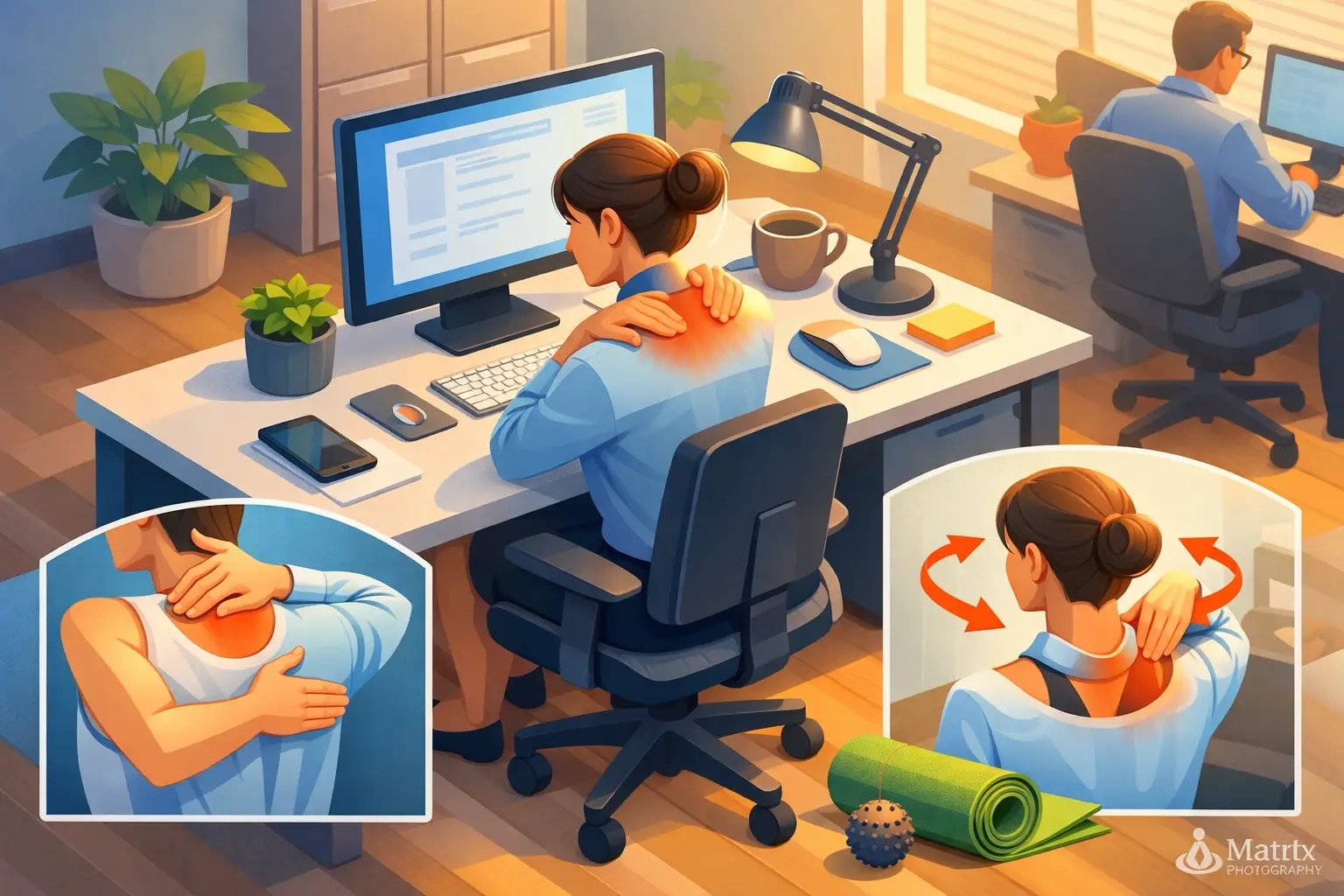
Your shoulders were not designed to spend eight hours quietly bracing around a keyboard. When a deadline is close, emails keep arriving, or a laptop screen sits just a little too low, the body often responds by lifting the shoulders toward the ears and holding them there. Learning how to relieve desk shoulder tension starts with noticing that pattern before it becomes the background noise of every workday.
A sore upper back is rarely caused by one single posture mistake. More often, it is the accumulation of stillness, stress, screen placement, repetitive mouse use, and a workspace that asks your body to work harder than it should. Small changes can make a meaningful difference, especially when they are repeated throughout the day.
Why Desk Work Settles Into the Shoulders
The neck, shoulders, upper back, and chest work as a connected system. When you lean forward to read a screen, reach for a mouse, or hold your head slightly ahead of your torso, the muscles along the back of the neck and tops of the shoulders may stay active to support you. The upper trapezius and levator scapulae are common places to feel that familiar tight, knotted sensation.
Stress can add another layer. Many people unconsciously clench the jaw, narrow the breath, and elevate the shoulders while concentrating. Even a carefully arranged workstation cannot fully offset hours spent in a state of tension. That is why lasting relief usually comes from a combination of better ergonomics, frequent movement, calming the nervous system, and hands-on care when needed.
The goal is not to hold a perfectly rigid posture all day. Bodies generally feel better when they can change position often. Think of your setup as a place that makes comfortable movement easier, rather than a device that locks you into one correct position.
Set Up Your Workspace for Less Shoulder Strain
Start with the screen. The top third of your monitor should generally sit near eye level, so you are not repeatedly bending your neck down. If you work from a laptop, a separate keyboard and mouse can help you raise the screen without forcing your arms into an awkward reach. A laptop stand, a stable stack of books, or an external monitor may all work, depending on your space.
Keep the keyboard and mouse close enough that your elbows can remain comfortably near your sides. Reaching forward or outward for the mouse can quietly overload one shoulder, particularly on a busy day full of clicking and scrolling. Your forearms should have support from the desk or chair armrests without being forced to shrug.
Adjust your chair so your feet can rest firmly on the floor or a footrest. A chair that is too high can leave your feet dangling and encourage shoulder elevation as you try to reach the desk. A chair that is too low may pull you forward toward the keyboard. The right height is the one that lets you sit supported, with your shoulders soft rather than drawn up.
If you use a phone often for work, avoid wedging it between your ear and shoulder. Use speakerphone, headphones, or a headset when possible. This simple adjustment can spare the neck from a surprising amount of repeated strain.
Give Yourself Movement Cues
A well-designed desk is helpful, but no chair makes prolonged stillness restorative. Build movement into the rhythm of your work instead of waiting until discomfort is intense. Stand when you take a call, walk to refill water, or look away from the screen while a document loads.
A practical approach is to take a brief reset every 30 to 60 minutes. It does not need to interrupt your productivity. Even one minute of movement gives overworked muscles a chance to release and improves circulation to tissues that have been holding the same position.
Five Minutes to Relieve Desk Shoulder Tension
These gentle movements are intended to feel soothing, not aggressive. Move slowly, breathe normally, and stay out of sharp pain. If an exercise causes tingling, numbness, dizziness, or pain that travels down the arm, stop and seek guidance from a qualified health professional.
Start With a Shoulder Drop and Full Exhale
Sit or stand tall without forcing your chest up. Inhale gently, then exhale longer than you inhaled and allow both shoulders to melt downward. Repeat three to five times. The instruction sounds simple, but a long exhale can interrupt the stress response that keeps the shoulders on alert.
Try Slow Shoulder Rolls
Roll both shoulders up, back, and down in a smooth circle five times. Then reverse the direction. Keep the movement comfortable rather than making the circles as large as possible. This can ease the feeling of being stuck after a long stretch at the computer.
Open the Front of the Chest
Place your forearms lightly along the sides of a doorway, with elbows below shoulder height. Step forward only until you feel a gentle stretch through the chest and front of the shoulders. Hold for 20 to 30 seconds while breathing steadily. Tight chest muscles can encourage rounded shoulders, so opening this area may make it easier for the upper back to relax.
Stretch the Side of the Neck With Care
Sit on one hand or hold the edge of your chair to keep that shoulder down. Slowly tilt the opposite ear toward the opposite shoulder until you feel a mild stretch along the side of the neck. Stay for 15 to 20 seconds, then switch sides. Do not pull your head with your hand or force the range of motion.
Add a Wall-Supported Upper Back Reset
Stand with your back against a wall and let the back of your head rest gently against it. Bring your arms into a loose goalpost shape only as far as your mobility allows. Slide the arms slightly upward and downward a few times, keeping the motion slow. This encourages the upper back and shoulder blades to participate rather than asking the neck to do all the work.
Use Heat, Recovery, and Massage Thoughtfully
At the end of a demanding desk day, warmth can be especially comforting for muscles that feel guarded and stiff. A warm shower, heating pad used according to its instructions, or time in an infrared sauna may help the body shift from work mode into recovery. Heat is often best for generalized tightness, while a cold application may feel better after a fresh flare-up involving swelling or acute irritation.
Self-massage can also provide temporary relief. Use your fingertips or a massage ball against a wall to apply gentle pressure around the upper back, between the shoulder blade and spine, or along the chest muscles. Avoid pressing directly on the front or side of the neck. More pressure is not always better. If the area tenses harder in response, lighten your touch and pair it with slow breathing.
For recurring tension, professional massage offers more than a quick moment of comfort. A caring therapist can assess where your body is holding stress, work with the deeper layers of the upper back when appropriate, and customize pressure to your goals. Swedish massage may suit someone who needs calming, circulation, and relaxation. Deep tissue or sports massage may be a better fit for persistent muscular restriction, activity-related tightness, or a more focused recovery plan. The best choice depends on sensitivity, health history, stress level, and how your body responds to pressure.
At Matrix Massage & Spa, therapeutic massage can be paired with hydrotherapy amenities such as the infrared sauna, steam room, cold plunge, hydro massage, and relaxation lounge. For many guests, that combination creates the breathing room needed to move from a tense work posture into a more settled, restored state.
Know When Shoulder Tension Needs More Attention
Desk-related muscle tension is common, but it should not be used to explain away every type of pain. Consider medical evaluation if shoulder or neck discomfort follows an injury, becomes severe, keeps worsening, regularly wakes you at night, or comes with weakness, numbness, tingling, fever, chest pain, shortness of breath, or pain radiating into the arm or jaw.
It is also worth getting guidance when discomfort persists despite several weeks of ergonomic changes and gentle movement. A physician or physical therapist can help identify whether the issue involves a joint, nerve, tendon, or another condition that needs a different approach.
Your workday may still be full, but your shoulders do not have to carry every task as if it were urgent. Pause before the next email, let the breath deepen, release your grip on the mouse, and give your body a small reason to soften. Those quiet resets can become a reliable form of daily care.